Make the small hours smaller.
Long-term insomnia has a treatment. Most people are never offered it.
Six weeks of cognitive behavioural therapy for insomnia, two minutes each morning. The diary and your numbers are free, with no time limit. The full program is $14.99 CAD a month.
Why nothing has worked
You have probably already tried everything
- Tea
- Magnesium
- White noise
- A tracker
- Something from a pharmacy
None of it was silly. It is just not treatment.
What the guidelines recommend first, ahead of sleeping pills, is CBT-I: cognitive behavioural therapy for insomnia. It works by changing what you do around sleep, not by sedating you.
How it works
How the six weeks actually work
Two minutes, each morning
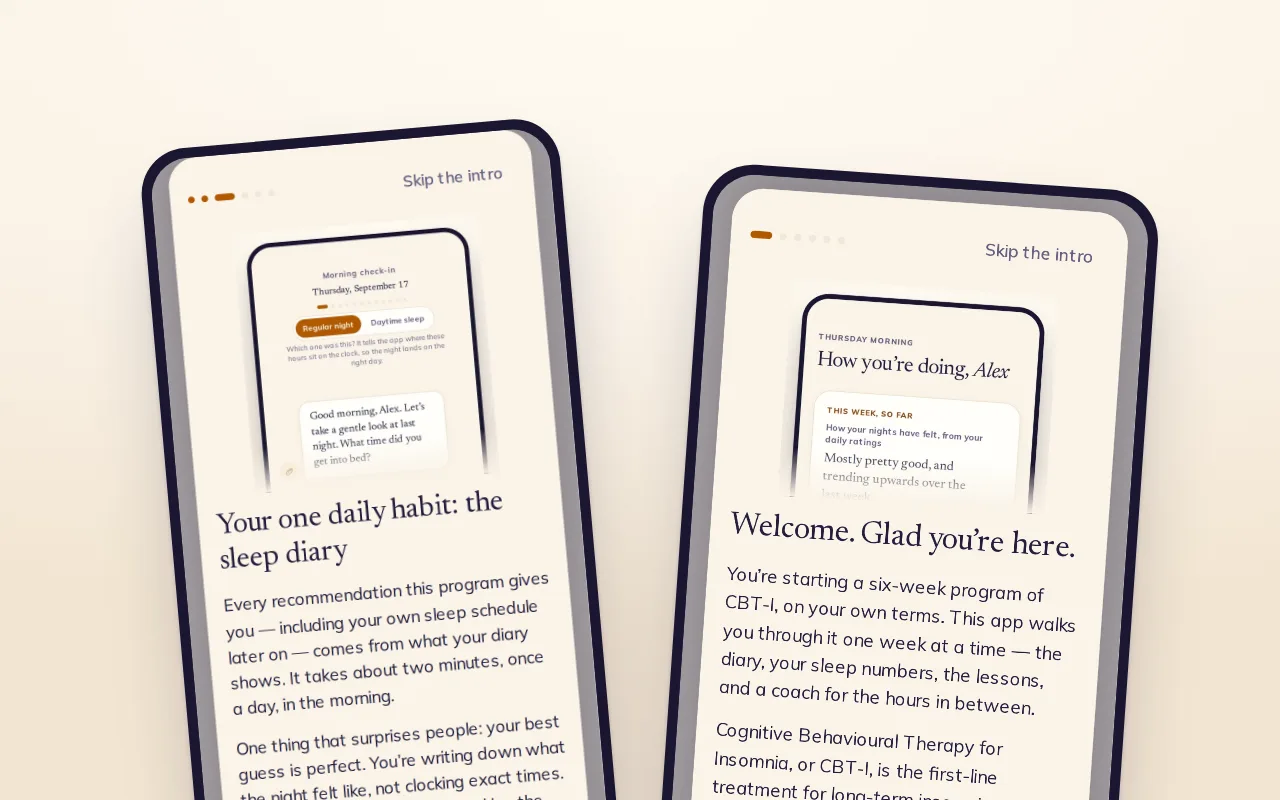
A short check-in about last night, answered from memory. Your best guess is the right answer: clock-watching is discouraged in this treatment.
Your own numbers do the deciding
The app works out how much of your time in bed was actually sleep, each night and as a weekly average.
One considered change a week
Each week the app recommends one change to your time in bed, from a fixed published table. You choose which end of the night.
CBT-I is a defined clinical method, not a set of tips. The coach specialises in CBT-I, works from that same material, and is not allowed to invent clinical advice.
There is no sleep score here.
No grade out of a hundred, nothing to wear, nothing to buy. What matters is your weekly average: one bad night inside a good week is still a good week.
What it looks like
Six weeks, in your pocket
Example screens, with a made-up person's diary.
Before you sign up
The part we would rather tell you now
For the first couple of weeks this usually feels harder, not easier. That is the method working, not failing: less time in bed means more pressure to sleep.
Week two is where most people stop. The app is built for that week: a weekly trend instead of a nightly verdict, and a specialist CBT-I coach for the hardest hours.
What it costs
What it costs, plainly
Free, with no time limit
- Your sleep diary — Two minutes each morning.
- Your sleep-efficiency numbers — How much of your time in bed was sleep, nightly and weekly.
- Your weekly sleep window — One recommended change to your time in bed each week, from a fixed, published table.
- Weeks 1 to 3 — Every lesson, plus the Game Plan lesson that opens weeks 4, 5 and 6.
No trial clock on any of it, and no card needed. If you never subscribe, these keep working.
Free for your first 3 weeks
- A specialist CBT-I coach, any hour — It's AI, but not a general chatbot. It coaches the way a CBT-I specialist would, from your own diary and the week you're on, and remembers what you've told it. Use it on your own or between visits with your doctor, any hour of the night. It is not allowed to make up clinical advice.
- A progress report for your doctor — Charts of your own diary, to email, print or bring to an appointment.
Starts when you sign up. No card, and nothing is charged when it ends.
To keep going
$14.99 CAD / month
Or $8.33/monthBilled as $99.99 CAD once a year. 44% less than paying monthly.
- The AI coach and the progress report — For as long as you subscribe.
- Weeks 4, 5 and 6 — In the order they build on each other. They stay open if you cancel.
Cancel any time in Settings. The coach and the report keep working until the end of the month or year you last paid for. Weeks 4 to 6 stay open after that, and the free parts stay free. On the monthly plan you can pause for 1 to 3 months instead.
Questions
Questions people ask first
Is this therapy?
It is the program a therapist would take you through, delivered as an app. It is not a therapist, not medical care, and it does not diagnose anything.
I take something to help me sleep. Can I still do this?
Yes, and keep taking it exactly as you do now. Nothing here asks you to change a medication. If coming off something is your goal, that is a plan you make with the doctor or pharmacist who prescribed it.
Do I need a smartwatch or a sleep tracker?
No. The diary is all it needs.
I have had this for twenty years. Is it too late?
Long-standing insomnia is what this program is for. Left untreated it tends to keep coming back rather than fade.
What happens to what I write in the diary?
It is health information and treated that way: never sold, never shared with advertisers. The privacy page lists exactly what is stored and how to ask for deletion, and you can read it before signing up.
Start tonight
The diary is free. Tomorrow morning's two-minute check-in is day one of the program.
Create your free accountAlready have an account? Sign in
On an iPhone? Here’s how to get the app
When this is not the right tool
Small Hours is built for adults with long-term trouble sleeping. It is not a substitute for medical care, it does not diagnose anything, and it will not tell you how your sleep is likely to turn out. If you are dealing with a health problem that affects your sleep, or you are taking medication for sleep, work through whichever applies with your doctor. The app is designed to sit alongside your doctor's care, not to replace it.
One moment…